Consciousness of Sheep
Related Articles

We woke up yesterday morning to the news that two oil tankers had collided in the Straits of Hormuz. It is not clear whether the collision was entirely accidental or a consequence of Iranian jamming of navigation systems. Nor – for the moment – does Iran seem to want to block the Straits entirely… not least because the bulk of the 20 million barrels of oil which pass through it every day are bound for Iran’s ally China. Nevertheless, blocking the Straits, and cutting a large part of the world’s oil and LNG supplies is one of the responses Iran can use in response to any US/NATO escalation of the conflict with Israel. And, although downplayed in western establishment media, this might be a catastrophe in the making because of the global economy’s reliance upon oil.
The western establishment media might – and the US neocons undoubtedly do – discount the threat because the USA remains a major supplier of oil and gas, especially to Europe following the self-inflicted loss of cheap Russian gas, so that the main impact would be on China. Unfortunately, things are not that simple because – as we found out during the pandemic – global supply chains are complex and intertwined. And somewhat like the bubbles that pop up in cheap wallpaper, it is impossible to predict where and when shortages will arise. In the UK during the first weeks of the first lockdown in 2020, we experienced a shortage of eggs. Not because hens had stopped laying, but because of a shortage of small (six and twelve) egg cartons which, it turned out, were only manufactured in three factories in all of Europe.
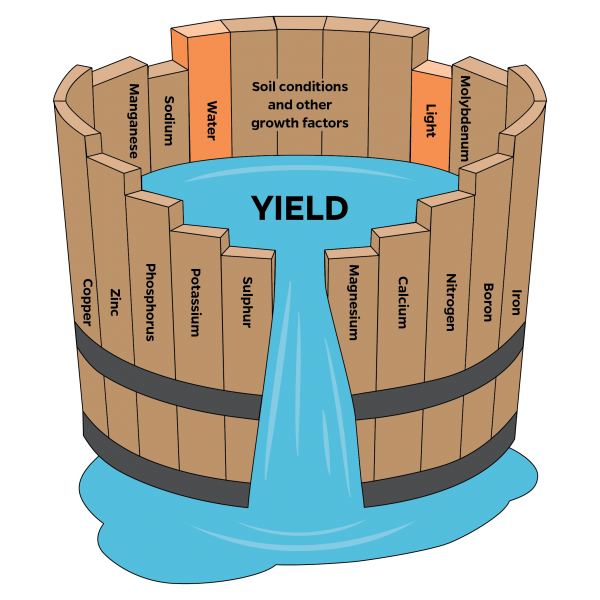
This was an example of why planners apply Justus von Liebig’s “law of the minimum” to complex systems… such as the modern global economy. Liebig had been interested in plant development, where increasing abundant nutrients did not increase growth where other essential nutrients were unavailable. The image of a barrel with different length slats is often used to help explain this. But the additional problem in something as complex as the economy is that there will likely be thousands of limiting factors, most of which will only be understood in hindsight.
Certainly, oil is a limiting factor in an economy that relies on heavy and middle distillates to power more than 90 percent of its transportation. And it is doubtful that China would simply take the hit to its oil supply. Most likely, Russia would simply re-route its “black fleet” (which currently supplies Europe indirectly) to China. In any case, it is likely to be secondary shortages resulting from oil shortages and/or high prices which cause the most damage across the western economies.
We experienced a taste of this in the UK a little over 25 years ago, when a protest by farmers and lorry drivers brought the economy to a standstill in just a few days. The initial crisis results from a change in people’s behaviour. Any hint of fuel shortages will trigger big queues at filling stations which never have enough fuel to meet more than a normal level of demand. And so, filling stations run dry, further fuelling the panic. Emergency services too, will change their behaviour to preserve fuel, while public transport operators will cut services just at the point where demand for them is rising. Nevertheless, deliveries to shops and supermarkets will be cut, causing shortages of some food and consumer products.
In September 2000, it was unexpected shortages which threatened the biggest disruptions. The inability to deliver key purifications chemicals to the water industry, for example, threatened the supply of clean drinking water, with the risk of a return of diseases like dysentery and cholera. Hospital surgical departments in some regions were forced to close because of a shortage of suture – all of the other requirements for operating were present, but without the ability to sew the patients up afterward, operations had to be cancelled.
In the end, a compromise was reached between the protesters and a government which had already activated emergency powers to bring the protest to a halt. But behind the scenes, government officials had been shocked by the speed with which the UK economy had unravelled. Not least because, when the dust settled, it turned out that more than 90 percent of deliveries had got through. But the loss of less than 10 percent of deliveries in a complex and just-in-time system was all it took to initiate a “cascading collapse.”
The term cascade refers to the interconnectedness of critical infrastructure systems such as the electricity grid, fuel system, water and sewage, transport, banking, and health. A failure in any one system will relatively quickly spread to the others. For example, in the event of a blackout, such as happened in Iberia last month, the water supply will be cut to large areas of the UK because of the reliance on electric pumping. The same goes for – among other things – filling stations, supermarket tills, and ATMs. A loss of fuel resulting from oil shortages might cascade less rapidly. But as we saw in September 2000, once the supply of key components for critical infrastructure cannot be delivered, the cascade accelerates.
Perhaps the least obvious source of cascade is, ATMs aside, the banking and financial system. However, we are already seeing the world oil price rise sharply solely in response to the threat of oil shortages. And, because of the weakness of the western economies following two years of lockdowns and three years of the proxy war in Ukraine, a prolonged spike in oil prices may well trigger a major financial crisis on a scale far greater than 2008. But even this would be trivial in comparison to the world economy suddenly losing a fifth of its oil with no idea when supply would be restored. Talk of $300-per-barrel oil has been raised by some media outlets. Although, given the growing weakness of western consumers, any oil price above $80-per-barrel simply means economic collapse.
The obvious knock-on impact of so big a spike in oil prices is that an already vulnerable banking and financial system, ultimately propped up by governments which have no possibility of repaying their own debts, is that almost all bank lending – including to each other – will dry up. Not only that, but the entire system of letters of credit and insurances which – for now – mean that when I buy strawberries from my local supermarket, everyone along the supply chain all the way back to the Chilean farm labourer who picked them get paid the correct amount on time. And when the system breaks down… well, as Charles Eisenstein wrote in the wake of the 2008 crash:
“What we call recession, an earlier culture might have called ‘God abandoning the world.’ Money is disappearing, and with it another property of spirit: the animating force of the human realm. At this writing, all over the world machines stand idle. Factories have ground to a halt; construction equipment sits derelict in the yard; parks and libraries are closing; and millions go homeless and hungry while housing units stand vacant and food rots in the warehouses. Yet all the human and material inputs to build the houses, distribute the food, and run the factories still exist. It is rather something immaterial, that animating spirit, which has fled. What has fled is money. That is the only thing missing, so insubstantial (in the form of electrons in computers) that it can hardly be said to exist at all, yet so powerful that without it, human productivity grinds to a halt.”
All too rapidly, global trade disintegrates and national economies are forced to relocalise. But in attempting to do so, they will experience another dimension of complexity… lock-in. Food production in advanced western economies is focused on the global rather than the economy, with most food production exported. On the other side of this, most food consumption is imported. And while, given time, local – or at least regional – agriculture could be reconfigured for domestic consumption, this can’t happen quickly enough to prevent serious shortages in the short-term.
In a basket-case economy like the UK, where 50 years of neoliberal offshoring has left us dependent upon imports for almost everything from the most ephemeral media subscription service to the components that maintain our life support systems. So that, in the event the alchemists in the City of London were no longer able to work their magic, millions of us would starve, succumb to diseases of an earlier age, or die from hypothermia attempting to leave the cities with little idea where to go… something that, I suspect, will impact the professional-managerial class far harder than those in the precariat class more used to eking out a living.
As you made it to the end…
you might consider supporting The Consciousness of Sheep. There are seven ways in which you could help me continue my work. First – and easiest by far – please share and like this article on social media. Second follow my page on Facebook. Third follow my channel on YouTube. Fourth, sign up for my monthly e-mail digest to ensure you do not miss my posts, and to stay up to date with news about Energy, Environment and Economy more broadly. Fifth, if you enjoy reading my work and feel able, please leave a tip. Sixth, buy one or more of my publications. Seventh, support me on Patreon.