 Consciousness of Sheep
Related Articles


It is election time again here in the UK. On Thursday, voters in Scotland and Wales, will choose who will represent them in their respective parliaments. And on the same day, 5,014 seats in 136 English councils are up for re-election. Although not directly affecting the UK parliament, polling has consistently shown that the results will be damning for the Labour/Tory uniparty. In Scotland and Wales, the respective pseudo-nationalist parties are expected to win. While across England Reform and the Greens look set to win the most seats.
Despite attempts by the establishment media to raise interest in the elections, most voters – assuming they can be bothered to vote at all – are looking for any party which appears to be anti-establishment so as to give the uniparty a bloody nose. And so, the usual debate around policy programmes is superfluous. Nobody seriously expects the politicians to deliver what they promise simply because the political class is no longer capable of delivering much of anything. High speed rail link between London and the north? Nope. New, 3.2GW nuclear power plant to replace the UK’s ageing nuclear fleet? Nope. An electricity grid that can handle more wind farms? Nope. 300,000 new houses a year? Nope. A tunnel under Stonehenge? Nope. This is no accident; this is failure by design. And it is as true of less prominent failures like antisocial behaviour, knife crime, the collapse of local high streets and the exponential growth of potholes.
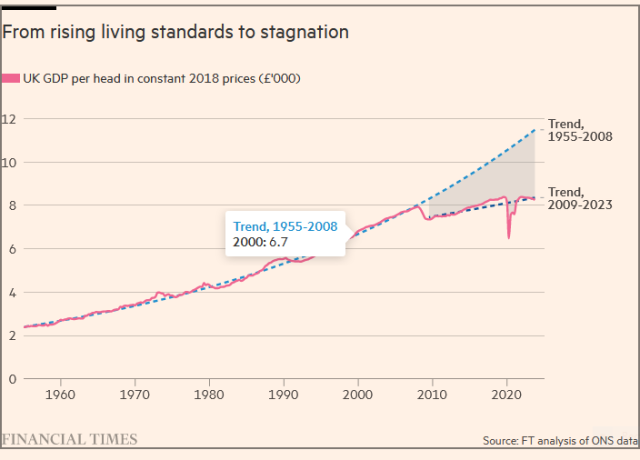
The reality is that the UK economy has been a slow-motion train wreck since the crash in 2008, with most people’s living standards falling ever since. This, in turn, has impacted both business profit margins and government tax income – one reason why government is now in the early stages of a sovereign debt crisis as the cost of borrowing spirals out of control:
The scope for political parties to offer positive change has been shrinking accordingly. Indeed, they have mostly given up on the usual offers of freebies, instead raising fear about what their opponents will do. As I warned more than a decade ago (before Brexit, lockdowns, the Russian energy sanctions and Trump’s adventures in the Persian Gulf):
“Because of our current economic woes, politicians are less able to provide us with rewards. As we progress into an uncertain future, politicians increasingly utilise our fear to encourage apathy and compliance. They ruthlessly utilise the insights provided by neurobiologists, psychologists and behavioural economists to prevent the rest of us from using our rational neo-prefrontal cortex to start to seriously address the predicament that we all find ourselves in.”
According to the political zealots, voting Reform will kill your granny, while electing Plaid Cymru will result in Wales being turned into a holiday camp for foreign rapists and murderers. A vote for the Greens is, apparently, a vote for antisemitism, while voting Labour will result in us all being carted off to the gulag… you get the idea, vote for our (thoroughly unpleasant) party or you’ll get something far worse. Little wonder so many people choose not to vote at all.
In the almost magical post-war decades 1953-1973, and even in the debt-based boom of the 1990s, we could cope with the usual political idiocy because there was sufficient prosperity for businesses and households to adjust. But today’s political landscape looks a lot like the fear raised by Bertrand Russell in his essay The Triumph of Stupidity:
“The fundamental cause of the trouble is that in the modern world the stupid are cocksure while the intelligent are full of doubt. Even those of the intelligent who believe that they have a nostrum are too individualistic to combine with other intelligent men from whom they differ on minor points…
“It is, I think, undeniable that the best men of the present day have a wider and truer outlook, but the best men of that [pre-1914] day had influence, while the best men of this are impotent spectators.”
Even as voters head off to the polling stations on Thursday morning, the Strait of Hormuz remains closed, with no prospect of reopening anytime soon. The result – with a roughly 60-day time lag as the last tankers from the Middle East are emptied and refineries and governments draw down reserves – is the biggest energy shock in the history of industrial civilisation. Estimates vary from mid-May to early June 2026 of the moment when actual shortages materialise… although the UK’s particular vulnerability in aviation fuel will see flight cancellations and airline bankruptcies before May is out.
Bigger problems are just over the horizon though. Because, while many economists and government advisors draw comfort from our being broadly less reliant on oil than we were during the 1974 and 1979 oil shocks, as oil industry expert Christof Rühl writing in the Financial Times warns:
“Unfortunately, the improvements in oil intensity are a double-edged sword. Oil consumption today is more concentrated in high-value uses and in areas where there is no substitute, like road or air freight and maritime shipping. These are load-bearing economic activities, less price sensitive than discretionary or consumption-oriented drivers of growth. Once disrupted they are likely to cascade through the economy…
“Today, price increases will hit the high-value use of oil which cannot be substituted. The cost then is the loss of economic activity and value creation, caused by shutting down a particular node. Oil concentrated in high-value uses is a little bit like rare earths, tiny compared with the size of GDP but essential for much of it. If the size of a supply disruption requires demand to come down and prices surge to the required level, the response will be sudden with a potentially unforeseen and disproportionate impact on economic activity.”
While large numbers of people having to forego holidays abroad – which will at least reduce carbon emissions – will result in frustration and a political backlash, the impact on the wider economy will be limited. Particularly if governments take action to maintain strategically important cargo flights. By far the bigger threat comes from the looming shortage of diesel fuel, which threatens to cripple agriculture and essential transport… it is a lot harder to cheer the carbon reductions when the trucks that bring food to the supermarkets stop running.
Shipping fuel too, is getting harder to access. And this spells catastrophe to a UK economy which is dangerously exposed to critical imports, including some 45 percent of the food we consume. And this is all the more dangerous because it is entirely beyond government control. While a competent government would have already begun rationing diesel fuel, it would take concerted international action to manage shipping fuel shortages. So that, even if essential transport might be maintained within the UK, if the supplies we depend upon fail to reach our ports, it will make no difference.
Even if the Strait of Hormuz opened tomorrow, the damage might take years to fully overcome. And the crisis is not limited to fuel. As I write, Europe ought to be filling its gas storage with LNG from Qatar. A small amount of the shortage is being made up with gas from the USA, but the likely shortfall points to power cuts this winter. And beyond that is the growing fertiliser shortage which will inevitably cause food shortages going into 2027.
What this adds up to is an economic and political crisis on a scale that no previous generation of politicians has ever had to deal with. When US President Harry S. Truman placed a sign on his desk saying ‘the buck stops here,’ he wasn’t taking the blame for the many problems that pre-dated his presidency, but for his being the person who had to deal with them… the buck could not be passed. The same will go for the creatures who have put their names on the ballot papers for this week’s elections. The proverbial is already hitting the fan. And part of the deal when we vote for them is that they take responsibility for fixing – or at least mitigating – the mess.
In this sense, these are good elections to lose. Because nothing in our comfortable, urbanised, energy-intense lives has prepared us for the shortages that are coming. And nothing in the now well-established politicians’ career path will have prepared those being elected – or even the officials who will advise them – for what is coming. At a time when public distrust in the political system and growing hostility to the politicians themselves was already growing, losing on Thursday may prove to be the better outcome.
As you made it to the end…
you might consider supporting The Consciousness of Sheep. There are seven ways in which you could help me continue my work. First – and easiest by far – please share and like this article on social media. Second follow my page on Facebook. Third follow my channel on YouTube. Fourth, sign up for my monthly e-mail digest to ensure you do not miss my posts, and to stay up to date with news about Energy, Environment and Economy more broadly. Fifth, if you enjoy reading my work and feel able, please leave a tip. Sixth, buy one or more of my publications. Seventh, support me on Patreon.
