Consciousness of Sheep
Related Articles



And so, Britain has seen the back of its sixth prime minister in ten years. Trawling through the musings of the political commentariat though, you would be hard pressed to learn why Keir Starmer just resigned. At the superficial end of the spectrum are those who point to his robotic personality and absence of charisma – something he shares with Tory prime ministers Theresa May and Edward Heath. And certainly, his failure to show any empathy toward the families of the Southport murder victims at the beginning of his term marked him out as someone lacking normal human emotions. But more thoughtful commentary focuses on his – many – policy failures.
Whether incoming governments really do enjoy the mythical 100-days of popular support following an election is questionable in the current period. Nevertheless, an incoming government might want to use its first days in office to set the tone. Starmer did it in spades, attacking vulnerable pensioners and disabled people before reneging on the pledge to increase taxes on ‘non-doms’ (people who temporarily reside outside the UK to avoid tax). Right-leaning commentators also point to examples of two-tier policing, while those on the left argue that Starmer’s failure to stand up to Israel led to his downfall. Both left and right argue that his authoritarian instincts over digital ID, banning protests, suspending elections and removing jury trials ran counter to majority views.
I would also add that Starmer’s neoliberal response to a series of closures of critical infrastructure at the very start of his term forced his government into an increasingly punitive debt trap in which government policy is constrained by the whims of a capricious bond market. That is, once the government had – probably unconsciously – surrendered to the ideology of neoliberal ‘market forces,’ any chance of delivering even a sliver of the ‘change’ that Labour had promised was lost.
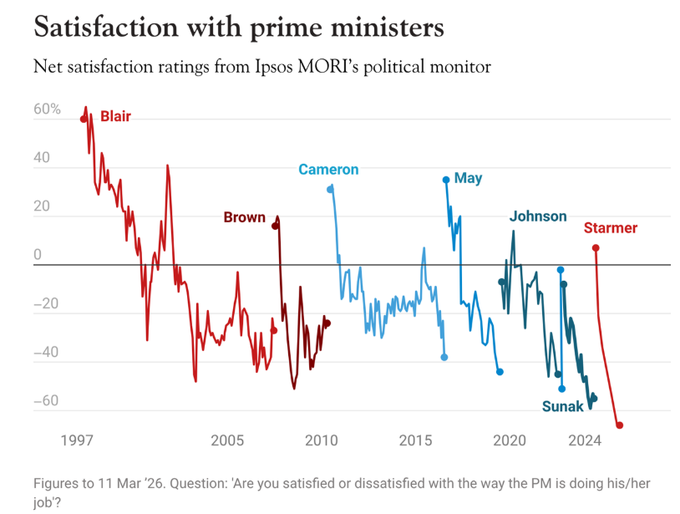
Tony Blair was the last prime minister to enjoy a reasonably long period of public approval. Not least because he arrived at the height of the debt-based boom of the 1990s. Brown, Cameron, May, Johnson and Starmer each enjoyed a brief period of approval (Truss and Sunak didn’t even get that) before their rating plummeted. And since each was a very different character and pursued different policies, there is clearly something much deeper going on.
We might express this as the ‘north-south divide’ – the ongoing collapse of the economies north and west of London and the southeast. Although even this doesn’t fully capture the difference in fortunes across the regions of the UK, where prosperity has retreated to an archipelago of affluent suburbs adjacent to government, finance and the top-tier universities even as swathes of ex-industrial, rundown seaside and small-town Britain have already joined the third world. What changed politically after 2020 was that a majority gave up on the idea that a change of government would lead to meaningful change.
This had been foreshadowed by the Brexit vote ten years ago when, given the rare opportunity to vote against the wishes of the political class, a majority did so. Cameron flounced out the following day, leaving someone else to clear up his mess. And his successor spent the best part of the next three years trying to figure out how to leave the European Union while maintaining all of its benefits… and throwing away her parliamentary majority along the way. Boris Johnson garnered some support due to his promise that he could get Brexit done – although the deal he negotiated could have been devised by a five-year-old. And his lockdown partying quickly condemned him to a return to journalism. Between them, Truss and Sunak almost succeeded in turning the Tories into a fringe party – at one point, polling ahead of the 2024 general election suggested that the Liberal Democrats may have become the official opposition. Starmer ‘won’ that election – getting 67 percent of the seats on just 32 percent of the votes in the first election where more people stayed at home than voted for the winning party. And in election after election since, the former ruling Tory/Labour duopoly have been fighting for fourth place behind reform UK, the Green party, the LibDems and (in Scotland and Wales) the nationalists.
This, more than the individual policy failures, still less personality, is the reason why the podium was rolled out in front of 10 Downing Street last Monday, and why Britain awaits the next participant to try their luck at remaining popular for longer than it takes for an ice cream to melt in the current heatwave. Nor is this anything new… so long as we are prepared to view the economics and politics of the last 47 years as something of an interregnum.
The ruling myth of the last four decades is that Margaret Thatcher rescued Britain from collapse by adopting monetarist policies and abandoning the post-war commitment to full employment. By allowing the UK’s outdated and unprofitable industries to collapse, Thatcher created the space for a new generation of leading-edge businesses to lead Britain back to prosperity. Like all myths, there were grains of truth within it. Unlike the USA, West Germany and Japan, British management hadn’t been through the ‘managerial revolution,’ and remained a relic of the Victorian age. As historian Dominic Sandbrook reminds us:
“A common explanation for manufacturing’s plight is that it was killed off by strikes, a view encapsulated by Basil Fawlty’s belief that car workers spent their time ‘lounging about on conveyor belts stuffing themselves with my money’. There is certainly no doubt that Britain’s fragmented labour movement, with hundreds of little unions competing for members, made for much more difficult industrial relations than in, say, West Germany. But as the former Financial Times editor Geoffrey Owen points out in his history of post-war industry, a glance at the figures tells a surprising story. Most workers were relatively unaffected by strikes, which tended to be concentrated in specific industries, above all cars, coalmining and shipbuilding, which were already suffering from much more serious problems…
“But the well-known symptoms of the ‘British disease’ – late starting and early stopping, poor timekeeping, the interminable tea breaks that infuriated George Lucas while filming Star Wars at Elstree – were the fault of management as well as labour. Indeed, many observers thought the real causes for British decline could be found in the boardroom, not on the shop floor. In many factories, the divide between management and workers remained absurdly stark, with different entrances, different canteens and different toilets…
“And although British workers were mocked abroad as greedy and lazy, more than a few observers thought the accusation should really be aimed at their bosses. ‘The executive rush hour in London begins well after 9.30 AM,’ wrote Bernard Nossiter. After a ‘leisurely mid-day break’ in the ‘panelled executive dining room’, the bosses were on their way home again to ‘Belgravia, Surrey or other executive haunts’ by 4.30.”
Even the idea that the UK was plagued by overly powerful trade unions misses the essential point made by both Harold Wilson and Edward Heath in the early 1970s, that the unions were too weak to keep the hotheads on the shop floor from opposing settlements agreed between the government and the union leaders. Nevertheless, a central element of the Thatcher myth is that she broke the unions. In truth, she was kicking at a door which had been opened by the flow of North Sea oil and gas which began arriving in large quantities in 1980.
In a period when it was cheaper to import coal and iron ore from Australia than to mine and transport it a few miles to the UK’s steelworks, and with a growing portion of Britain’s electricity being generated with oil and gas, the National Union of Miners was a busted flush. With a bit of stockpiling and an even bigger majority at the 1983 general election, Thatcher was ready to provoke what turned out to be the UK’s longest and most bitter strike. After 362 strike days – only made possible by the miners’ wives’ movement – the miners were forced back to work. And more importantly, the wider Labour movement was broken. Neil Kinnock abandoned his former socialist views in favour of defeating the left within his own party, paving the way for Thatcher’s self-professed greatest achievement: ‘Tony Blair and New Labour. We forced our opponents to change their minds.’
Blair was a lucky politician. He happened to be Labour’s rising star in May 1994, when Labour’s leader John Smith died. 1994 was also the year that the UK emerged from the economic downturn caused by the loss of oil and gas revenue after the 1988 Piper Alpha disaster. By the time Blair’s New Labour was elected in 1997, the UK economy was booming on a mountain of debt underwritten by the final increases in North Sea oil and gas production.
In 1999, oil and gas production in the UK sectors of the North Sea peaked. By 2005, Britain was a net importer of oil and gas… this time permanently. The debt though, Wile E. Coyote-style, kept flowing for another three years. Just enough for Blair to win his third election and to hand the leadership on to the hapless Gordon Brown in 2007.
The crisis which overwhelmed Brown in 2008 was global. But the UK’s vulnerability to it stems from the fact that neither Thatcher nor Blair had dealt with Britain’s underlying structural weakness stemming from the end of empire… an extreme version of the sunk cost fallacy.
Britain’s rulers squandered the wealth of three centuries of empire fighting the central powers to a standstill between 1914 and 1918. Just as Norman Angell had warned, the cost of war proved far greater than any benefits that flowed from it. The two empires most responsible for it – Russia and Austria-Hungary – vanished even before the war was over. Germany and the Ottomans battled on for a few more months before succumbing. Only Britain and France remained of the five empires which began the conflict. But, while on paper the British empire was at its peak in the 1920s, having taken over Germany’s colonies and administering parts of the former Ottoman Empire on behalf of the League of Nations, it was collapsing. Despite incorporating more than a quarter of the world population, the British Empire produced less than nine percent of its output. Worse still, as the USA led the world into the oil age, the UK was left with aged and increasingly uncompetitive coal-based industry.
Britain’s leaders though, could not bring themselves to voluntarily shrink from global dominance – and the voters weren’t about to elect anyone who suggested doing so. Indeed, the most bitter foreign policy issue during the inter-war years concerned Britain ceding a degree of self-rule to India (opponents like Churchill regarding it as a step on the road to a potentially violent and bloody Indian independence). Retreat from empire though, was the only sane long-term policy for a state that had blown its accumulated wealth in four years of industrialised slaughter.
The choice, in essence, was between maintaining control of the empire by raising the value of the pound or allowing the pound to fall to a rate at which Britain’s export industries would once again become profitable. The establishment chose the former, and on 28 April 1925, Winston Churchill reinstated the gold standard restoring the currency’s gold convertibility at its pre-war parity rate of $4.86 to the pound. Keynes led the objections, pointing out the calamitous impact of an over-valued currency on the ability of British industry to generate wealth:
“These arguments are not arguments against the gold standard as such. That is a separate discussion which I shall not touch here. They are arguments against having restored gold in conditions which required a substantial readjustment of all our money values. If Mr. Churchill had restored gold by fixing the parity lower than the pre-war figure, or if he had waited until our money values were adjusted to the pre-war parity, then these particular arguments would have no force. But in doing what he did in the actual circumstances of last spring, he was just asking for trouble. For he was committing himself to force down money wages and all money values, without any idea how it was to be done…”
It was inevitably short-lived anyway. In September 1931, in the face of the Great Depression, the gold standard was abandoned. Leaving in its wake the mass unemployment and the soured industrial relations of the late 1920s, which set the tone for future industrial mistrust.
Unlike the supposed losers of the Second World War – West Germany and Japan – which had successfully established a tripartite system of industrial relations in which state, unions and employers worked to create prosperity as the prerequisite for public spending, wage increases and profits, the UK maintained its pre-war enmity. Despite this, with post-war reconstruction largely complete and with a switch from coal to oil as the primary energy source, Britain’s employers and workers enjoyed the economic boom that was improving lives across the western economies.
Even so, post-war governments had repeated Churchill’s error – overvaluing the pound in another ill-fated attempt to maintain an empire which was considerably weaker than it had been in 1925. For all of the beneficial reforms introduced by the 1945-51 Labour government, its biggest error was to squander its Marshall Aid dollars on a military that its economy could no longer afford, even as it maintained the pound at an overvalued $4.05. By 1949, the government faced a crash down to $2.80. And in 1956, the relative impotence of the British military was made visible when the Eisenhower administration forced it to abandon its Egyptian adventure to ‘liberate’ the Suez Canal.
Out of that geopolitical humiliation came a development which condemned the UK’s export industries to a lingering death. The introduction of capital controls in the face of the ensuing run on the pound led the City of London banks to create the London Eurodollar market. This was largely a deregulatory device which allowed banks to escape all regulation of transactions in a foreign currency between parties outside the UK. That is, the banks had discovered a means of creating US dollars (or, strictly, dollar denominated debt) outside the USA and with no oversight by either the Federal Reserve or the Bank of England. It didn’t take long for the Wall Street banks to move their international operations to London to take advantage of the deregulation. And so, the system of international exchange that continues to this day was born. And, crucially, it meant that the City of London emerged as a major component of the UK economy… one whose need for a strong currency was entirely at odds with the needs of the UK’s domestic economy.
In 1957, when Harold Macmillan told the British people “You have never had it so good,” he may not have been lying, but he was hiding an inconvenient truth about the post-war prosperity that most voters were enjoying. With rising incomes came rising consumption. And all too often, consumption meant importing consumer goods from UK industry’s competitors. This left successive governments using up their gold and foreign currency reserves to maintain the value of the pound. This became most apparent in October 1964 when a labour government promising to unleash the ‘white heat of technology’ was returned to office. While new Labour ministers salivated at the prospect of massive public investment in leading-edge businesses, when the new Chancellor, James Callaghan arrived at the Treasury, he was met with a far more pessimistic mood. Far from unleashing more public spending, his officials informed him, the only way of maintaining the value of the pound was to implement austerity cuts and tax rises to dampen down household consumption.
This was the start of the “British disease” that plagued Labour and Tory governments for the next 15 years. During which, inevitably, the pound was devalued anyway. And other than a brief reprise – caused by the post-1971 decline in the value of the dollar – the pound kept falling even as it remained too high for the UK’s manufacturing base to attract the investment required to modernise.
Thatcher’s response was simply to give up. Allow the pound to float against international currencies and withdraw state aid to struggling industries. The result was devastating. Between 1980 and 1982 a net 1,149,000 jobs were lost as Britain’s manufacturing base collapsed. The situation was made all the worse by the arrival of exportable quantities of North Sea oil and gas, which further increased the value of the pound. As William Borders at the New York Times reported at the time:
“[Thatcher’s supporters] like to point to the one bright spot on the economic horizon: the steadily swelling flow of oil from the North Sea. With current production of 1.7 million barrels a day, exceeding such giants as Indonesia and Kuwait, Britain has become self-sufficient in oil, saving this country billions of dollars in import bills…
“But even that good news has a dark side. The oil production has been a major factor in the appreciation of sterling, which is now trading at a level 50 percent higher than in 1976. Though good for some people in Britain, the strong pound has had a devastating effect on exporters, making their goods more expensive abroad…
“Sir Michael Edwardes, the chairman of BL Ltd., the automobile company that used to be called British Leyland, expressed a widely held view among industrialists when he declared in exasperation that, if the Government could not figure out a way to keep the oil from hurting big business, it should ‘leave the bloody stuff in the ground.’”
The sale of oil and gas in dollars provided the foreign reserves that Britain’s decimated manufacturing base no longer could. At the same time, the tax receipts from oil sales provided Thatcher with the means to provide social security to millions of unemployed households. And whenever the coffers appeared to be running dry, the government could sell off public assets at bargain basement prices to maintain the UK’s foreign reserves.
The collapse of the manufacturing base wasn’t unforeseen, it was deliberate policy. Thatcher’s Chancellor Geoffrey Howe referred to it as ‘managed decline.’ While the government continued to prop up the pound and deregulate the City of London, everything north and west of Southeast England would be left to wither on the vine – social security and special projects would hide the worst of what was happening even as a more paramilitary police force would impose public order with riot sticks and baton rounds.
The debt-based boom following the ‘big bang’ deregulation in 1986 brought a decade or so of relief. With banks creating currency out of thin air on a scale never seen previously, a portion of the ‘wealth’ seemed to trickle down. And politicians and economists of the day could convince themselves that generating real wealth no longer mattered. Financialised countries like Britain, they told themselves, could simply import the material goods they needed using money borrowed into existence from a banking system providing financial services to the wider world.
It is a tribute to the power of narrative that this misunderstanding persists even after the 2008 crash and the ongoing depression that has followed. But since the North Sea peaked and declined, governments have found themselves facing the same dilemma. Keeping the value of the pound elevated is the only way the mass of imports into the UK – including basics like food and energy – can be afforded. But – just as in 1925, 1964, and 1980 – an overvalued pound prevents the investment needed to restore Britain’s export industries.
For the majority of British people, living standards have gone backward since 2008. And politicians, economists and statisticians pointing to rising stock prices and artificial GDP growth serves only to anger people still further. So that, even as successive Chancellors seek to maintain the value of the pound by the age-old combination of tax increases and austerity cuts, investors have lost confidence while the mass of voters switch to the parties of the extreme left and right in search of some alternative.
No such alternative exists – within the current system – of course. And so, the length of prime ministers’ terms of office are compared to the time vegetables take to decay. So that, even as Andy Burnham is being gifted the keys to 10 Downing Street, it is only a matter of time before he too becomes as unpopular as his predecessors. And the process will rinse and repeat until the political class is forced to bring the value of the pound down to a level in line with the UK’s atrophied export base.
As you made it to the end…
you might consider supporting The Consciousness of Sheep. There are seven ways in which you could help me continue my work. First – and easiest by far – please share and like this article on social media. Second follow my page on Facebook. Third follow my channel on YouTube. Fourth, sign up for my monthly e-mail digest to ensure you do not miss my posts, and to stay up to date with news about Energy, Environment and Economy more broadly. Fifth, if you enjoy reading my work and feel able, please leave a tip. Sixth, buy one or more of my publications. Seventh, support me on Patreon.