Consciousness of Sheep
Related Articles



The price of diesel fuel topped £2.00 per litre in parts of the UK on Monday. With the average price still hovering around £1.97, we are still below the July 2022 record price caused by the sudden leap in demand when the Covid lockdowns came to an end. But this time is different because there is a lack of global supply capacity to make up the shortfall. And analysts expect the price of diesel to rise above £2.30 in the next few weeks.
But why stop there? The two proximate causes of the diesel shortage are the ongoing NATO targeting of Russian diesel refining capacity and the Chinese ban on diesel exports put in place last March – China may have helped prevent an absolute oil shortage by drawing down its massive reserves, but without its refining capacity a global diesel shortage is inevitable. Add to this the earlier and economically illiterate decision by neoliberal western states to cut their diesel refining capacity because Russia and China could supply it at a lower price, and there is no reason why the price of diesel at the pump shouldn’t rise to £3.00, £5.00, or even £10.00 per litre… by which time, of course, only the richest people in the richest countries would be able to purchase the stuff.
One difficulty here is that, far from being expensive, diesel fuel is unconscionably cheap. Even at £2.00 per litre, diesel is cheaper than a bottle of Pepsi Max at the local supermarket. And it is because the price trivialises the benefits that we underestimate the risk from shortages. The late Richard Heinberg used to explain the benefit we derive from that litre of diesel in this way – imagine you broke down and had to push an average diesel car like a Ford Focus or Volkswagen Golf the 10 miles to your home. How long would that take you? In truth, almost all of us would collapse with exhaustion long before getting home. But a strong athlete might manage the feat in perhaps nine hours (although probably having to rest and recuperate periodically too). But that litre of diesel will complete the journey in just 15 minutes (less if it is along a good A-road) – that’s the benefit that we get from diesel, and it is why it is viewed as the lifeblood of the global economy.
This was something economists like Adam Smith and Karl Marx almost got right but ended up dangerously wrong about. Marx correctly reasoned that for capitalists to make a profit, some of the inputs into the productive process had to be paid less than the value they provided. But then, drawing on Smith’s labour theory of value, Marx claimed that the underpaid input was labour. This was not entirely wrong. And at the time Smith was writing, when horses and labourers were the main source of energy to a preindustrial economy, labour had been a source of value (although even then, the water which powered early manufactories and the wind which propelled the ocean’s sailing ships was far more powerful). But the arrival of coal-powered steam engines – which was well underway in England when Marx was writing – turned everything on its head. It cost just pence to mine a ton of coal in early nineteenth century England. And yet the work that that ton of coal provided was equivalent to 11-years of human labour. That was the input to the productive process which was paid significantly less than the value it returned. And had Marx developed an Energy theory of value, then the world might have been a happier place.
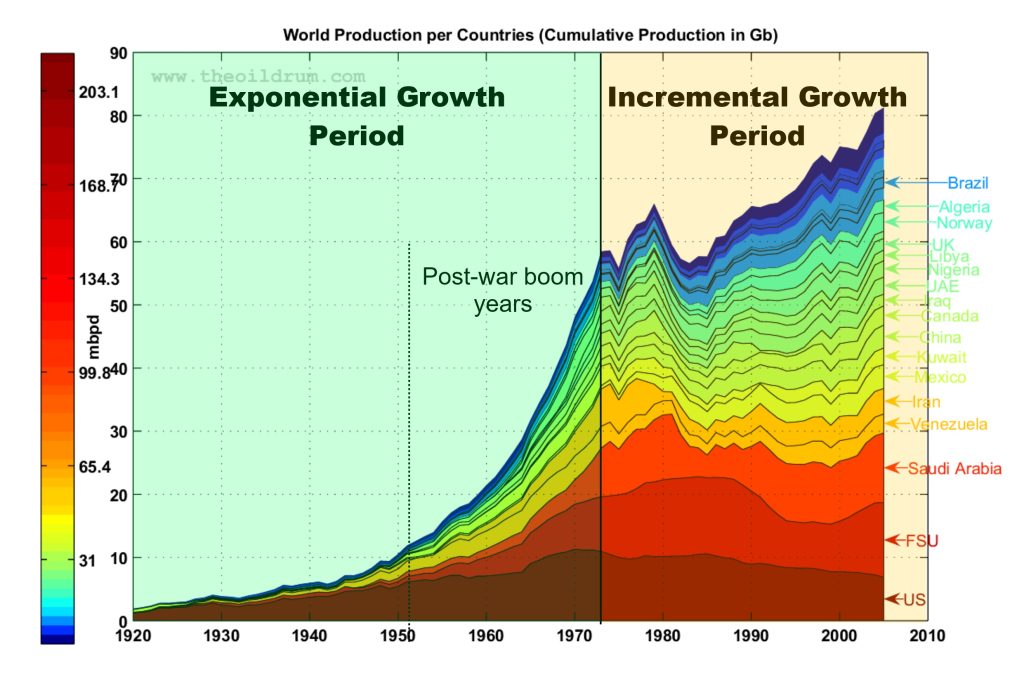
The oil age – beginning in the USA in the late nineteenth century and spreading to the rest of the developed world in the early twentieth century – saw even more massive wealth creation, particularly during the spectacular boom years which followed reconstruction after the Second World War. As historian Paul Kennedy observed:
“The accumulated world industrial output between 1953 and 1973 was comparable in volume to that of the entire century and a half which separated 1953 from 1800. The recovery of war-damaged economies, the development of new technologies, the continued shift from agriculture to industry, the harnessing of national resources within ‘planned economies,’ and the spread of industrialization to the Third World all helped to effect this dramatic change. In an even more emphatic way, and for much the same reasons, the volume of world trade also grew spectacularly after 1945…”
 Diesel was central to this, doing the heavy lifting that no alternative energy source could manage, powering agricultural, industrial and mining equipment; propelling 2,000 tonne railway trains along hundreds of miles of track; moving container ships across the world’s oceans; and allowing huge trucks to move 40 tonnes of goods at a time across a growing road network. At a perhaps less essential level, smaller jobs like digging trenches, cutting down trees or mixing concrete, each became far easier with the development of diesel-powered tools… even the sacred wind turbines so beloved of the ‘just stop oil’ crowd would be impossible to deploy were it not for the steady flow of diesel fuel.
That’s the crisis facing domestic economies around the world. Because diesel fuel is not just another cheap product as easily thrown away as a bottle of Pepsi, as the supply dries up so almost all the things we take for granted in a modern industrialised way of life become more difficult. The additional cost of the fuel ends up on the bill for every good and service – including essentials like food and water – which depends upon diesel for transport. During the September 2000 fuel protests for example, supermarkets imposed food rationing while hospitals had to cancel operations because the suture used to repair wounds could not be transported.
That was an economic example of Liebig’s Law of the Minimum (first applied to plant growth) that a system fails due to its least available input rather than through an across-the-board drought. A hospital might have all the clinical staff, pharmaceuticals, anaesthetics and technology required for surgery. But without the suture to sew up the patient afterward, the operation can’t go ahead. The same goes for all our critical and not-so-critical infrastructure. If the truck that transports any one component cannot move for lack of diesel, then the entire process has to stop – the chemical needed to produce clean water, the yeast needed to make bread, the hard drives needed to keep communications systems running… the loss of any one input brings the entire system down. And in an absolute shortage of diesel fuel, lots and lots of key inputs are going to fail to arrive.
This ought to be the primary concern of the government as there is no end to the current crisis in sight. But the government is facing a bigger short-term pressure to lower the price of diesel fuel. This is certainly within the government’s gift since it charges a flat rate 52.95p per litre duty on diesel and then charges 20 percent VAT on top of that. Because the increased price at the pump will eventually feed through into general prices which, in turn, will appear in the official inflation figures, government ministers will no doubt be tempted to cut duty and/or VAT to offset the rising prices faced by consumers… one suggestion being to levy a windfall tax on the oil companies to replace the taxes lost on fuel.
Windfall taxes, however, do not conjure more diesel into existence. Indeed, in the longer term they may deter investment in new diesel refining capacity. More importantly, lower prices are the very worst response to a growing shortage. This was first noticed by economist William Stanley Jevons in response to the development of more efficient steam engines in the 1860s. At the time, most economists and politicians believed that more efficient engines would lead to less coal use. But Jevons argued that instead, efficiency would cause the price of coal to fall and that the lower price of coal would cause more people to consume it. This is now known as the ‘Jevons paradox’ – that efficiency leads to more consumption.
While cutting duty and taxes on diesel would not be improving efficiency, it would create the same effect. At lower prices, we will collectively consume more diesel. And if – as was true at the end of lockdown – the price increases had been the result of a temporary mismatch between supply and demand, that wouldn’t be so much of a problem. Refineries would simply ramp up production and soon supply and demand would be in balance, with prices falling accordingly. But we are not facing a temporary mismatch, we are in the early stages of the biggest energy shock in human history… and with no end in sight!
In effect, we are in the early stage of rationing by price. This is a form of what economists call ‘demand destruction’ – as prices increase, so households and businesses are forced to cut their spending, ultimately causing demand to fall. The problem is that this form of rationing can be grossly unfair and potentially dangerous. At £2.00 per litre, little Tarquin and Charlotte’s mummy can still ferry them to school in the diesel-powered armoured people carrier they call ‘the family car.’ But at £2.00 per litre, transport firms are forced to jack up prices, care workers can no longer afford to look after their elderly and disabled clients, and trades people like plumbers and electricians can no longer respond to emergencies. And as the price increases, so more and more things we currently take for granted become impossible. But heaven forbid that the children have to walk to school.
Sooner or later, government will be forced to implement rationing by necessity. This means releasing what remains of the national reserve while diverting fuel to where it is most needed to maintain emergency services and the supply of food. For most of us, there will be a limit on the amount of fuel which we can buy – which may be a problem for trades people and care workers who are unlikely to be afforded essential status.
Logically, given that there is no end to the growing shortage in sight, resisting the pressure to cut tax and duty while introducing early rationing by necessity would be the least damaging course of action. Unfortunately, it would also be the least popular for the politicians who have to take the decision. In practice, until the wider electorate is already materially impacted by diesel shortages, politicians will follow the path of least resistance and cut taxes on fuel. This is the Jevons horn of the government’s dilemma. The other is that, by the time the politicians make the decision to ration, some of the many inputs to our way of life will already be missing. This is the Liebig horn of the dilemma… we will only close the gate after the proverbial horse has bolted. At which point we will learn one of the crucial lessons of physics – without energy, things break down… mostly unpredictably.
As you made it to the end…
you might consider supporting The Consciousness of Sheep. There are seven ways in which you could help me continue my work. First – and easiest by far – please share and like this article on social media. Second follow my page on Facebook. Third follow my channel on YouTube. Fourth, sign up for my monthly e-mail digest to ensure you do not miss my posts, and to stay up to date with news about Energy, Environment and Economy more broadly. Fifth, if you enjoy reading my work and feel able, please leave a tip. Sixth, buy one or more of my publications. Seventh, support me on Patreon.