Consciousness of Sheep
Related Articles


Britain’s Chief Secretary to the Treasury Emma Reynolds sparked a small controversy in political circles this weekend by drawing an arbitrary distinction between ‘employees’ and ‘employers.’ The argument itself turned on whether or not the Labour government had raised the taxes paid by ‘working people.’ Ms Reynolds told a GB News interviewer that:
“I don’t think employers are working people, they are companies.”
And, asked about someone who is self-employed, she replied that:
“No, but you’re an employee probably of your company, and I’m saying there is a difference between employers and employees.”
The comments drew considerable opprobrium from various trades people and small business owners who pointed out that they were ‘working people’ who had been hit hard by tax increases such as last year’s steep increase in Employers’ National Insurance along with higher Business Rates. Some also raised the broader point that 60 percent of UK employees work in Small and Medium sized Enterprises (SMEs) which have been disproportionately taxed in comparison with large, often transnational, corporations.
The row about taxes is something of a sideshow. In the end, so long as our over-indebted government insists on playing to the current rules, ever more taxes must land on domestic businesses and households because of the difficulty of taxing overseas wealth… a problem that is multiplied by an aging and unhealthy population in a climate in which the surplus energy which drove economic growth has all but disappeared.
More important is what Ms Reynold’s comments disclose about the Marxian taxonomy the current government is applying to the economy. Not that the government is in any way Marxist, but because Marx’s distinction between capital and labour has pervaded most leftist thinking. That is, Reynold’s distinction between employers and employees is merely a technocratic version of Marx’s distinction between bourgeois and proletarian (capitalist and worker). Which is all well and good, except that it bears little resemblance to the complexity that we mere mortals must live within.
Even the terms ‘employee’ or ‘worker’ have to do a lot of heavy lifting in a modern economy which has little in common with the industrial England that Marx observed. Perhaps the immiserated mass at the base has the similarity of precariousness – today’s gig workers and zero-hours contractors facing something similar to the plight of the day workers queuing outside the docks or the factory in the hope of getting a day’s work… although the combination of Universal Credit and charity makes life just a little easier for the modern precariat.
Above those is the army of poorly paid service workers whose employment may be a little safer but is still predicated on a level of consumption which has been difficult to sustain over the past 16 years. Then there are the massed ranks of white-collar clerical workers in both public and private sectors doing what the late David Graeber called ‘bullshit jobs’ in the service of an increasingly bloated technocracy. The last vestige of the old working class being the relatively small number of workers in what remains of the UK’s – mostly foreign-owned – manufacturing base.
This leaves lots of people out, of course. At the top are those who do not need to work because they hold sufficient wealth that they are able to live off the interest. But closer to the bottom is a host of people who might better be thought of as ‘job owners’ – self employed people who must work at least as hard as any employee… and often with a level of risk like that of the precariat. Adjacent to these are ‘job renters’ – various franchisees who pay a percentage to a brand owner, such as the person running your local newsagent, pub, or McDonalds. A few of these may turn over enough money to get into the far more difficult and taxing (in the broadest sense of the word) process of employing other people. And those who are particularly fortunate may even grow their business to a size at which it becomes attractive to the acquisitions department of one of the multinationals (which is about as far as domestic growth ever gets in the UK these days).
The social security system has changed to reflect and to accelerate these changes. In the industrialised economy of post-war Britain, it had been possible to draw a line between the ‘employed’ and ‘unemployed’ – full employment leaving only those with health and/or social problems facing long-term unemployment. This began to change after the collapse of the Bretton Woods monetary system and the first oil shock in the early 1970s, with the emergence of an embryonic precariat pinballing between short-term employment and periods depending upon an increasingly punitive welfare system… the shift, via tax credits, to the current Universal Credit system allowing people to bounce in and out of work, to take on side hustles, or to become self-employed without losing the safety net of a basic income.
The category of ‘employees’ or ‘workers,’ then, might include at least eight subcategories:
- People who depend upon welfare but also engage in gig and zero-hours work
- People who depend upon welfare while engaging in side hustles (which may or may not become jobs)
- People who earn wages from part-time work which are topped up with welfare payments
- People who are waged employees of a company they do not own
- People who are salaried employees of private, public or third sector organisations
- People who own their own job but do not own it through a company
- People who own their job through a company they own
- People who own a job through a company they own which also provides waged employment to others.
The latter of these might also cross the boundary into the ‘employer’ category, which must stretch to encompass every kind of organisation from a local charity which pays a part-time administrator all the way up to a global behemoth like Amazon or Google. Even within the base SME category there are big differences between the 5,643,495 employing 0-49 people (most of which – 4,272,535 – being self-employed) and the 38,435 employing 50-250 people. There are also big differences in the type of work and levels of income SMEs engage in. While 16 percent of SMEs are in construction – including a large number of self-employed tradespeople, with a further 10 percent in hospitality and retail, where income may be relatively low, 14 percent are in Professional, Scientific and Technical activities where incomes will be relatively high.
It goes without saying that few of Britain’s SMEs come close to the turnover of the multinational corporations which have come to dominate the modern private sector. Which is why, yet again, it turns out that Marx was wrong. According to Marx, the upward arc of progress would result in the creation of just two classes, workers and capitalists (or employees and employers if we must Ms Reynolds) – the latter growing fat on the unpaid surplus labour of the former. I have explained elsewhere that it is surplus energy (of which labour power is a very weak variant) which is the true source of value. And it is from this error that we arrive at a level of complexity which makes a mockery of Marx’s claim that we would end up with just two classes. Indeed, we might even call into question whether Marx’s definition of ‘capitalism’ is adequate for our contemporary situation.
Certainly, the basic structures of central banks and joint stock companies existed when Marx was writing. But in his version, capitalism involved only the use of accumulated ‘wealth’ (in the form of money) being invested (as capital) into production to make more money at the end of the process. That still happens in what remains of the manufacturing base. But is it a sensible description of how Microsoft, Google or Netflix make profits? Does it account for the growth in vulture capitalists using leveraged buyouts to take over and screw-over previously functioning businesses such as Morrisons supermarket, TalkTalk internet, and Manchester United football club?
Marx wrote about the development of ‘credit money’ – i.e., fractional reserve banking – in the Grundrisse, but even this sleight of hand is dwarfed by the modern, computerised debt-based money creation which has turned the global banking corporations into the rulers of the planet (or at least of the Western parts of it) through debt fealty. Is it really ‘capitalism’ when banks create almost infinite volumes of credit to effectively enslave households, businesses and even governments, now so indebted that they can only print their way out of debt via inflation and a collapse in global supply chains.
Marx imagined that as the capitalist class became more homogenous and more exploitative, the working class in turn would become a ‘class for itself,’ determined to overthrow the capitalist system and replace it with a new system which would contain just the one class – the proletariat. And since this would mark the end of class conflict, the state itself would wither away. And one reason why the contemporary left is so resentful toward the working class is their belief that the working class failed their duty to overthrow the system in the late 1960s (Prague Spring, French general strike, anti-war protests in the UK and USA, etc.) and during the neoliberal revolution of the 1980s. But once we understand that it is inanimate surplus energy rather than labour which drives the economy, and that, far from there being a unified working class, there are a plethora of categories of worker with very differing interests, we also see that there was never going to be the proletarian revolution so beloved of the left.
Worse still, our failure to adequately describe the way the system has changed over the last half century – and, indeed, since the dawn of the industrial age – prevents us from understanding the predicament we are now in. Because the surplus energy – first coal and later oil – which has powered 250 years or so of industrial ‘progress,’ is drying up. Every one of us feels the effect of this in higher energy costs, lower standards of living, harsher business conditions and – if you are a government minister – the impossibility of managing the budget without getting ever deeper into debt. Each of us lashes out accordingly. Working people blame such things as immigration and exploitative corporations, business owners blame spendthrift governments and profligate local councils, while government ministers and bureaucrats blame feckless workers and unproductive businesses… and, of course, we can always find examples of each. But they are merely symptoms which will worsen if the cause is left unattended.
We might summarise our predicament as rising debt in the face of declining energy. The current, Trump-induced, energy shock is at least providing an insight into the importance of energy. At its most trivial, households are having to cut back on driving (there has also been a noticeable decline in road speeds as motorists try to eke out more miles per gallon). Tradespeople are having to pass on fuel costs to those of their customers who can still afford to pay. Freelance truckers, faced with a raft of de facto taxes like congestion and emissions charges, are simply giving up… making the cost of everything transported on a lorry all the more expensive. Costs up, incomes down, and suddenly the government is raising less in tax than it had forecast. Nevertheless, this is largely artificial, allowing us to imagine a day when things go ‘back to normal.’
But ‘normal’ also has to do a lot of work here because the world hit peak energy at the end of 2018. The lockdowns in 2020 and 2021 help hide this, while the Ukraine conflict masked its effects. However, previously available mineral resources around the world were locked in during the pandemic – the (energy) cost of recovering them now higher than the returns. The attempt to add non-renewable renewable energy-harvesting technologies to our energy mix has exacerbated shortages in key minerals like nickel, lithium and copper, where the cost of diesel has rendered some mining operations unprofitable.
It is not that the world is about to ‘run out’ of energy – although, in my book breakdown I make the case that we are now ‘running out’ in the same way that a motorist who has begun driving just after filling the tank is running out. Furthermore, our predicament is more complicated because while we are roughly halfway through the planet’s hydrocarbon reserves, we have also consumed the cheapest and easiest reserves first. This means that we have to spend more energy to obtain useful energy with each passing year with the result that the energy available to drive the economy is shrinking, pushing us toward a net energy cliff edge:
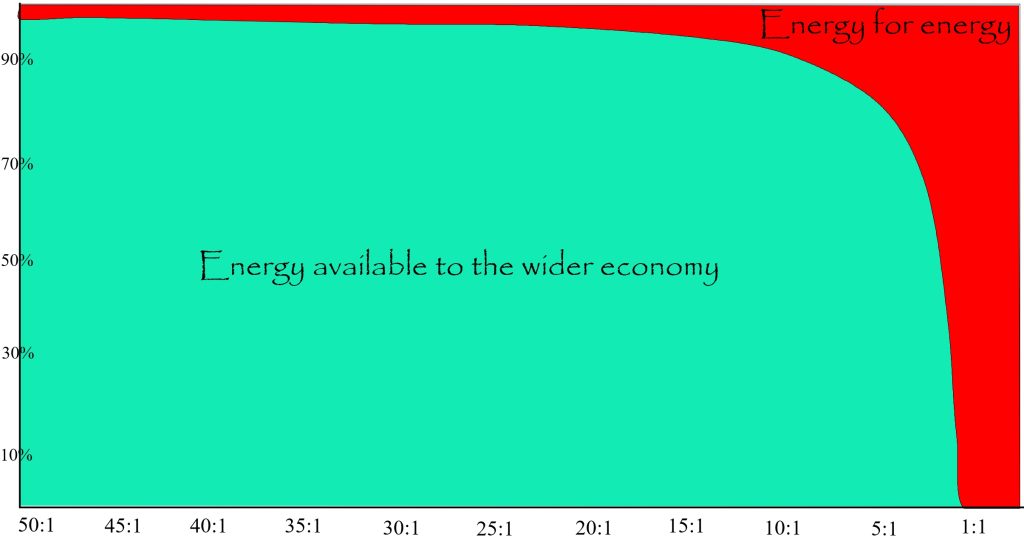
Nor is this the end of the problem, because our built environment, including critical infrastructure is not self-sustaining. Not only do we have to divert an increasing proportion of our energy to obtaining energy, but we must also divert some to maintaining our physical economy. This though, results in a predicament of its own because wear and tear also follows a cliff – ignoring relatively cheap repairs results in more expensive repairs later on. And often – particularly with concrete structures where the decay is internal and invisible – rather than an expensive repair, the result is a catastrophic collapse.
This is but one side (albeit the real material one) of our predicament. The other is found in a financial economy where banks – both domestic and international – have been allowed to create new currency out of thin air. And, as was revealed in 2008, banks have created a complex financial architecture to hedge against the inherent risks which, in the face of a collapse in global demand for debt, can very rapidly unravel.
Okay, saying banks create money out of thin air is a little flippant because nobody borrows currency just to look at it. And banks don’t simply lend new currency to anyone who walks through the door. Rather, modern banks use complex algorithms to determine which households, businesses and governments are ‘credit worthy.’ Which means not only which are most likely to repay the debt with interest, but also which has assets that can cover the debt if it goes bad.
In short, every new dollar, euro or pound lent into existence is tied to a real asset in the material world… which is why falling net energy is so much of a problem, because the incomes which were supposed to repay the debt shrink when there is not enough energy – raw and embedded – to go around. So that, in a system in which there is never enough currency in circulation to repay the debt and the interest, not only must we maintain incomes, we must generate enough demand for further debt to repay the existing interest… a form of red queen syndrome if you will. Failure to do so really is catastrophic. As Charles Eisenstein observed in the months after the 2008 crash:
“What we call recession, an earlier culture might have called ‘God abandoning the world.’ Money is disappearing, and with it another property of spirit: the animating force of the human realm. At this writing, all over the world machines stand idle. Factories have ground to a halt; construction equipment sits derelict in the yard; parks and libraries are closing; and millions go homeless and hungry while housing units stand vacant and food rots in the warehouses. Yet all the human and material inputs to build the houses, distribute the food, and run the factories still exist. It is rather something immaterial, that animating spirit, which has fled. What has fled is money. That is the only thing missing, so insubstantial (in the form of electrons in computers) that it can hardly be said to exist at all, yet so powerful that without it, human productivity grinds to a halt.”
This time is different insofar as, in the grip of the biggest bubble the world has ever inflated, it is not just money which is going away. This time around we no longer have access to ‘all the human and material inputs…’ As surplus energy falls and the cost of maintaining and growing the material economy passes beyond the returns it delivers, one form or another of catabolic collapse or managed degrowth is the only option available… and nobody knows how to do that!
This is hardly the future that Marx and his leftist inheritors wanted. Nevertheless, it is an increasingly obvious one to anyone paying attention – even if the cause I have set out here is less well understood. And it is why the simplistic taxonomy behind Emma Reynold’s comments is so disappointing… although all too characteristic of the modern political class. Far from dividing the world into capitalists and workers, we might do better to divide the world into those who have first access to the money banks create out of thin air or, indeed, who gets disproportionately more or less of the surplus energy we collectively generate. In the end though, no matter how we divide up the economy in theory, in a world without growth, the more urgent question is how do we best allocate the surplus energy and material resources remaining to us? And I fear that this is a question that the current political class is particularly ill-equipped to answer.
As you made it to the end…
you might consider supporting The Consciousness of Sheep. There are seven ways in which you could help me continue my work. First – and easiest by far – please share and like this article on social media. Second follow my page on Facebook. Third follow my channel on YouTube. Fourth, sign up for my monthly e-mail digest to ensure you do not miss my posts, and to stay up to date with news about Energy, Environment and Economy more broadly. Fifth, if you enjoy reading my work and feel able, please leave a tip. Sixth, buy one or more of my publications. Seventh, support me on Patreon.